
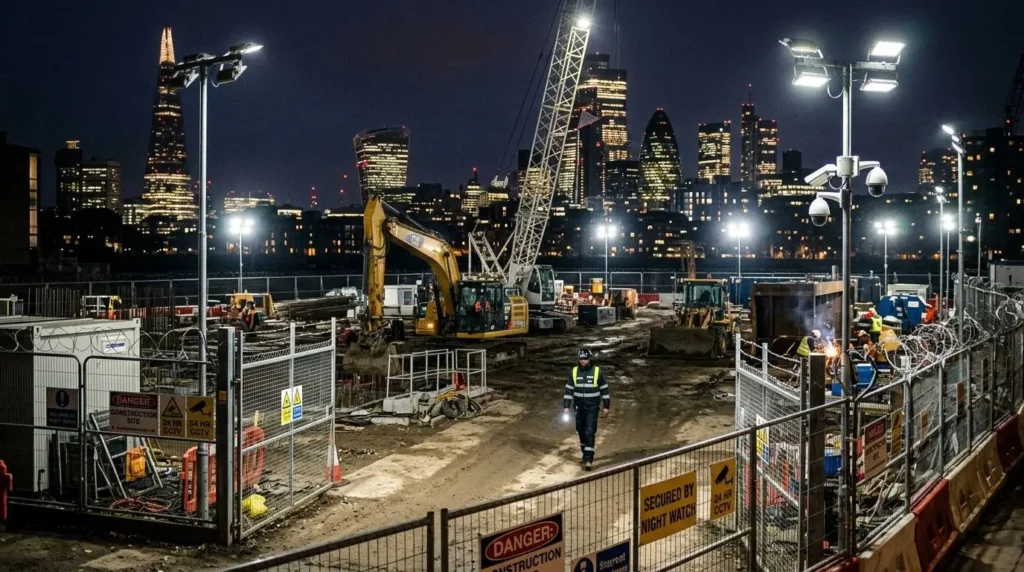
Construction site security is one of the most underestimated operational responsibilities in the UK building industry. Sites are consistently among the highest-targeted commercial environments in the country for theft, vandalism, and unauthorised access, yet the security arrangements on many active builds would not hold up to serious scrutiny. The problem is rarely a lack of awareness. It is a lack of structured, joined-up planning that accounts for how a construction environment actually behaves across a project lifecycle. This guide covers what that planning looks like in practice and where most sites are leaving themselves exposed.
Why Construction Site Security Demands a Different Approach
Most commercial premises have a fixed layout, a permanent workforce, and a perimeter that does not change from one month to the next. Construction sites have none of those things. The footprint shifts as the build progresses. The workforce fluctuates daily as subcontractors rotate on and off-site. High-value plant machinery, copper wiring, power tools, and raw materials are left on site overnight and across weekends with varying degrees of protection.
This combination makes construction site security a fundamentally different challenge to securing an office block or a retail unit. The threat is not just external. UK site theft data consistently shows that a significant proportion of losses involve individuals who have had prior legitimate access to the site. That changes how access management, documentation, and accountability need to be approached.
HSE obligations add another layer of complexity. A security failure on a construction site is not only a financial event. Depending on the circumstances, it can trigger regulatory scrutiny, particularly where unauthorised access leads to injury or where inadequate fencing contributed to a third-party incident. Construction site security planning, therefore, needs to sit within the wider health and safety framework from day one, not be bolted on as an afterthought.
Securing the Perimeter Before Anything Else
Every credible construction site security plan starts with the perimeter, and the perimeter on a construction site is never static. What constitutes the boundary of the site on day one of groundworks looks very different to the boundary six months into a structural build, and different again when fit-out begins. A security plan that does not account for this will develop predictable gaps as the project evolves.
HSE guidance on construction site fencing sets minimum standards for hoarding height and integrity, but meeting the minimum is not the same as managing risk effectively. Hoarding needs to be inspected regularly for damage, gaps, and points of easy access that develop over time through wear or incidental contact from site activity.
Vehicle access should be consolidated to a single, monitored entry and exit point wherever the site layout allows. Multiple informal access routes are one of the most consistent vulnerabilities on active UK builds. When vehicles and personnel can enter and leave through several points, tracking who is on site at any given time becomes practically impossible.
Lighting is a passive but highly effective deterrent that many sites underinvest in. Motion-activated flood lighting across material storage areas, plant compounds, and perimeter boundaries significantly raises the risk calculus for opportunistic intruders. It also supports CCTV coverage by ensuring usable footage is captured in low-light conditions. Signage indicating active CCTV monitoring, security patrols, and restricted access is both a legal requirement in many circumstances and a practical deterrent in its own right.
Access Control and Workforce Management on Site
Formalised sign-in and sign-out procedures are the foundation of effective access control on a construction site. Every worker, subcontractor, delivery driver, and visitor should be logged on entry and exit with identity verified against an expected register. In practice, this process erodes on many long-running projects as familiarity sets in and informal habits develop. That erosion is where accountability breaks down.
CSCS cards provide a baseline for verifying that workers have the qualifications and training relevant to their role on site, but they are not a substitute for active access management. High-risk zones within the site, including plant storage areas, materials compounds, and site offices, should have restricted access with a documented list of who is authorised to enter and why.
The broader principle here is that robust access control is as much about creating an accountability trail as it is about keeping unauthorised people out. When theft or damage does occur, a well-maintained access log significantly narrows the field of investigation and signals to everyone on site that activity is documented and traceable. That awareness alone changes behaviour over the course of a project.
How Professional Patrols Strengthen Construction Site Security
Static guarding, where an officer is stationed on site throughout the night, is the most visible form of professional construction site security, but not always the most practical or cost-effective option for every project. For many mid-sized UK builds, mobile patrol coverage achieves a comparable deterrent effect at a fraction of the cost, particularly when visits are varied in timing and route to avoid predictable patterns.
Professional mobile patrols provide GPS-documented proof of attendance, incident reporting after every visit, and a defined escalation route in the event of an alarm activation or observed breach. That documentation matters for insurers as well as for internal project management. A site that can demonstrate structured, recorded overnight security coverage is in a materially stronger position when making a claim than one that cannot.
Emergency Cover Services become particularly relevant in a construction context when unplanned gaps in security coverage arise. Project transitions, staff absences, or unexpected delays can leave a site in a period of reduced oversight. Having a provider with rapid response capability and the flexibility to cover those gaps without a lengthy contracting process is an operational asset that many site managers only appreciate after they have needed it and not had it.
When selecting a patrol provider for a construction environment, SIA-licensed officers are a baseline requirement, not a premium. Beyond licensing, the quality of incident reporting, the specificity of response time guarantees, and the provider’s familiarity with construction site environments are all meaningful criteria that affect what the service actually delivers.
CCTV, Alarms, and Technology That Actually Works on Site
The technology landscape for construction site security has improved considerably in recent years, but the practical constraints of a live build environment still limit what can be deployed effectively. Hardwired CCTV systems that work well in permanent commercial premises are often impractical on a construction site where power supply, layout, and access points are all subject to change.
Temporary CCTV systems designed specifically for construction environments are now widely available. Solar-powered, wireless units with remote monitoring capability can be repositioned as the build progresses and do not depend on a stable mains supply. Remotely monitored systems, where a control room receives live or near-live footage and can dispatch a response if suspicious activity is detected, are considerably more effective than recording-only systems that are reviewed after the fact.
Monitored alarm systems follow the same principle. An alarm that alerts a control room and triggers a verified response is operationally different from one that simply sounds and relies on a keyholder being available and willing to attend at 3am. The distinction between monitored and unmonitored technology is one that many site managers do not fully consider when specifying their security arrangements.
Asset marking and GPS tracking for high-value plant machinery is an underused layer of protection on UK construction sites. Marked and tracked equipment is both less attractive to thieves and significantly more recoverable if taken. Some insurers now factor this into premium calculations for plant-heavy projects, making it a financially practical investment beyond its security value.
Building a Construction Site Security Plan That Holds Up
A documented security risk assessment before work begins is the point where construction site security either becomes a coherent system or remains a collection of disconnected measures. The assessment should identify the specific risks presented by the site, the surrounding environment, the nature of the build, and the materials and plant that will be on site at each stage.
That last point is important. Security requirements change as a project progresses. A groundworks phase presents different risks to a structural phase, which presents different risks again to fit-out. A plan written once at the start and never reviewed will have developed significant gaps by the midpoint of any substantial project.
Coordination between the principal contractor, site manager, and security provider from the outset prevents the gaps that tend to appear when these parties are working from different assumptions about who is responsible for what. Construction site security works as a system when perimeter controls, access management, technology, and professional patrol coverage are designed to support each other. When they are specified independently by different parties at different points in the project, the result is usually a set of measures that each perform adequately in isolation but leave obvious weaknesses at the joins.
Construction site security is not a product you purchase once and consider resolved. It is an active operational commitment that needs to be managed, reviewed, and adjusted throughout the life of the project. The sites that handle it well treat it that way from day one.
FAQs
What are the most common causes of theft on UK construction sites?
The most common causes of theft on UK construction sites are inadequate perimeter security, poor access control, and the predictable overnight and weekend absence of any on-site presence. High-value targets, including copper wiring, power tools, diesel, and plant machinery, are consistently taken during out-of-hours periods when sites are unmonitored. Research also indicates that a significant proportion of site thefts involve individuals with prior legitimate access, making workforce accountability and access documentation just as important as external perimeter controls.
Is CCTV enough to secure a construction site overnight?
CCTV alone is not sufficient to secure a construction site overnight. Recording systems create an evidence trail after an incident, but do not prevent one from occurring. Even remotely monitored systems require a human response capability to be operationally effective. The most resilient overnight security arrangements combine monitored CCTV with professional mobile patrol coverage and a defined alarm response protocol, so that suspicious activity triggers an intervention rather than simply a recording.
What security measures are required on a construction site in the UK?
UK construction sites are subject to HSE requirements around perimeter fencing and site access control, as well as obligations under the Occupiers’ Liability Act regarding the safety of those who may enter the site without permission. Beyond the legal baseline, industry best practice includes documented access management, adequate lighting, CCTV coverage of high-risk areas, and professional security patrol provision for out-of-hours periods. Principal contractors also carry responsibility for ensuring that security arrangements are proportionate to the risk profile of the specific site.
How much does professional construction site security cost?
Professional construction site security in the UK is almost always quoted on a site-specific basis following a risk assessment. Mobile patrol coverage for a mid-sized active build typically starts from £500 to £900 per month, with larger or higher-risk sites running considerably higher. Static guarding costs more and is usually reserved for the highest-risk environments or specific project phases. CCTV installation and monitoring are typically priced separately. VAT applies to all quoted rates, and most reputable providers will offer a site visit before issuing a formal proposal.