
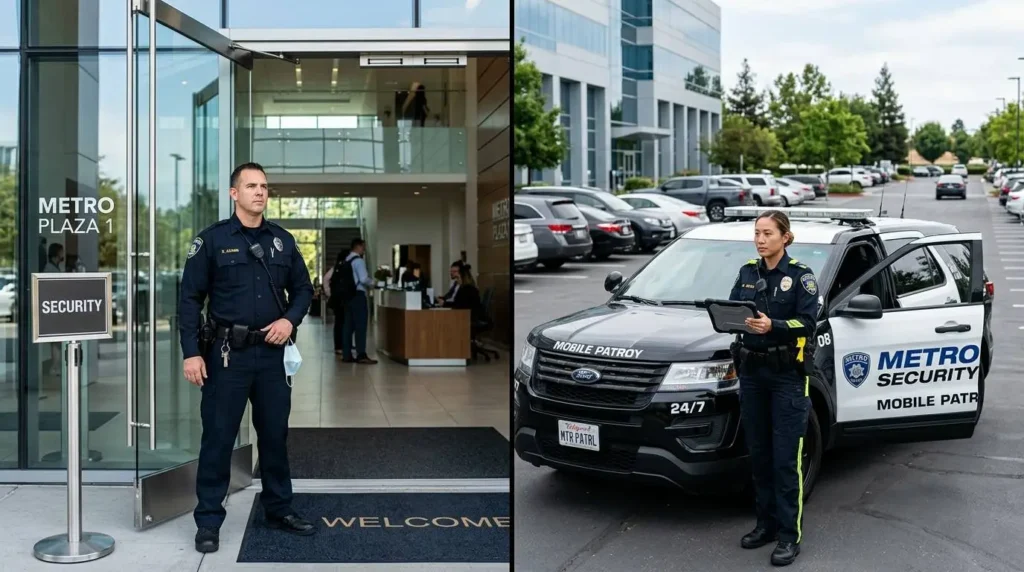
A facilities manager once described his security setup as a guy on the door and a camera system. When his insurer asked him to detail what was covered after 6 pm, he had no real answer. The camera recorded. The guard went home. Everything in between was essentially unmonitored. It is a situation more common than most businesses would admit, and it usually comes to light at the worst possible moment.
The choice between static guards and mobile patrols is one that every organisation with physical premises faces, even if they have never framed it in those terms. Getting it wrong does not always result in an incident. But when it does, the gap between what you assumed was covered and what actually was becomes very clear, very quickly.
Defining the Two Models: What Each One Actually Covers
A static guard is deployed to a fixed location. Their role is to be present, to manage access, observe their immediate environment, and respond to situations within their direct line of sight. They are effective within the space they occupy, and that is precisely the limit of their coverage.
A mobile patrol operates differently in almost every respect. Officers move between locations on a structured but unpredictable schedule, conducting physical checks, documenting findings, and covering ground that a fixed presence never could. Understanding static guards and mobile patrols as two distinct coverage models, rather than two versions of the same thing, is the starting point for making a sensible security decision.
Where Static Guards Deliver Real Value
There is a tendency in some security discussions to treat static deployment as the outdated option. That is not accurate. For specific environments and specific risks, a static guard is the correct and most effective choice.
Controlled access points are the clearest example. A building with a single entry, a busy reception, or a gate managing vehicle movements needs a person in place who can verify identity, manage flow, and respond immediately to a problem at that point. No mobile unit checking in every few hours replicates that. Static officers also provide the kind of reassurance that matters in customer-facing environments, a professional, visible presence that communicates to visitors that the building is managed and secure.
Events security, retail environments with high footfall, and hospital reception areas are all contexts where static guards and mobile patrols are not interchangeable. The static guard belongs here because the risk is concentrated, continuous, and requires immediate human intervention rather than periodic oversight.
What Mobile Patrols Offer That Static Cover Cannot
The defining feature of mobile patrol work is not simply movement. It is unpredictability combined with systematic coverage, and those two things together create a deterrent that a fixed guard cannot replicate across a larger site.
When a patrol officer visits a site, they are physically checking external perimeters, testing access points, looking for signs of tampering or forced entry, and documenting the condition of the site at the time of each visit. Those records, typically GPS-timestamped and available to the client, matter for insurance purposes and for any subsequent investigation. A static presence at one entrance provides no equivalent evidence of what was happening at the rear of the building, the car park, or the loading area at the same time.
Static guards and mobile patrols also differ substantially in how they scale. A mobile unit covers multiple client sites in a single shift, which means businesses can access a level of professional oversight that would be prohibitively expensive to replicate with a dedicated static officer per location. For multi-site operators, logistics hubs, and industrial estates, this is the practical reality that drives patrol-based security over fixed deployment.
The unpredictability element is worth dwelling on. A criminal assessing a target will observe patterns. A guard who arrives at the same time, checks the same points, and leaves at the same time every night creates a predictable gap. Mobile patrol schedules are deliberately varied to prevent exactly this. When considering static guards and mobile patrols from a deterrence standpoint, the randomised visit model wins on larger or more spread-out sites precisely because it cannot be anticipated.
The Risk of Choosing the Wrong Model
This is where a lot of procurement decisions go wrong, and it rarely gets discussed honestly. Choosing a static guard for a site that needs patrol coverage leaves the vast majority of the perimeter unmonitored for extended periods. If the risk is concentrated at a single point, that is a reasonable trade-off. If the risk is spread across a large site with multiple entry points, outbuildings, or open boundaries, it is not.
The reverse problem is equally real. Using a mobile patrol where a fixed presence is needed means nobody is managing access in real time. A mobile officer checking in three times per shift cannot prevent tailgating, manage a difficult situation at reception, or provide the immediate intervention a static post delivers. The decision between static guards and mobile patrols should start with a clear-eyed assessment of where the risk actually is and what response it requires, not with what appears cheaper or more familiar.
Businesses that pick a security model based on price alone tend to end up with coverage that fits the budget rather than the site. The shortfall only becomes visible when something goes wrong.
How the Two Models Work Together
The most effective security arrangements for larger or more complex sites are often hybrid ones. A static officer manages a controlled access point or reception during business hours, while a mobile unit covers the wider perimeter, additional buildings, or out-of-hours periods. The two models are designed to complement each other rather than compete.
This is particularly relevant in corporate & office security services, where a building may require active access management during the day and comprehensive perimeter coverage once staff have left for the evening. A single static guard cannot do both. A well-structured hybrid deployment can, and it is how most professional security plans for larger premises actually work in practice. When discussing static guards and mobile patrols with a provider, asking about combined deployment options is often where the most practical solutions emerge.
The Role of Alarm Response in the Decision
Neither model is complete without a clear plan for what happens when an alarm activates outside of scheduled cover. This is a gap that security planning often overlooks until it becomes urgent.
Key holding & alarm response services address this directly. A designated security officer holds access credentials and the legal authority to enter the premises on the client’s behalf when an alarm triggers. Mobile patrol officers are ideally positioned to provide this service; they are already on the road, already familiar with the site, and can attend in a fraction of the time it would take to mobilise a response from a central base. Integrating alarm response with your patrol arrangement means a single provider with full site knowledge is handling both routine oversight and reactive attendance. That continuity of knowledge is more valuable than it might initially appear.
Making the Right Choice for Your Premises
The question is rarely which model is better in the abstract. It is the model that fits the specific combination of risk, site layout, operating hours, and insurance requirements that your business presents.
Start with the hours. If your premises carry risk around the clock, what does each shift look like in terms of who is present and what they can physically cover? Consider whether your risk is point-specific, a single entrance, a server room, a cash office, or distributed across a site with multiple exposure points. Ask whether your insurer or sector regulator requires documented patrol logs or specific response time guarantees. Static guards and mobile patrols answer different questions, and the most useful thing a security professional can do in an initial assessment is help you identify which questions actually apply to your situation.
If the answer is not immediately obvious, it usually means your site warrants a proper assessment before any contract is signed.
Conclusion
The difference between static guards and mobile patrols is not a question of which is newer or which sounds more comprehensive. It is a question of fit. Both models have clear strengths and clear limits, and the businesses that get security right are the ones that understand those limits before they commit to a deployment. Choosing static guards and mobile patrols based on your actual risk profile, not on cost, assumption, or what a neighbouring business uses, is the practical starting point. If you are not certain which model your premises need, a site assessment with an experienced security team is worth arranging before the decision is made under pressure.
Frequently Asked Questions
What is the main difference between a static security guard and a mobile patrol?
A static security guard is positioned at a fixed location and provides continuous, immediate presence at that single point, managing access, observing their immediate environment, and responding to incidents within their area. A mobile patrol officer moves between locations on a varied schedule, conducting physical checks across a wider site or multiple sites. Static guards and mobile patrols are built around different coverage models rather than being interchangeable versions of the same service.
Which is better for a business: a static guard or mobile patrols?
Neither is universally better. The right choice depends on your site layout, operating hours, and the nature of the risk you are managing. A static guard suits environments with a concentrated, continuous risk at a specific point, such as a staffed entrance or a high-footfall reception. Mobile patrols are more effective for larger sites, multi-building premises, or after-hours coverage where the risk is spread rather than fixed in one location.
Can static guards and mobile patrols be used at the same site?
Yes, and for many commercial premises, a hybrid deployment is the most effective arrangement. Static guards and mobile patrols working in combination allow one officer to manage a controlled access point while a mobile unit covers the wider perimeter or attends to out-of-hours monitoring. This approach is common in office complexes, industrial estates, and any site where the security requirements change significantly between business hours and overnight periods.
Are mobile patrols more cost-effective than static guards?
For sites that require broad coverage across a large area or multiple locations, mobile patrols are typically more cost-effective because a single unit serves multiple clients per shift. A static guard represents a dedicated cost for a single fixed point. The cost comparison only makes sense relative to what each model actually needs to cover. Deploying a mobile patrol where a fixed presence is required, or vice versa, creates a coverage gap that no savings in cost can justify.