
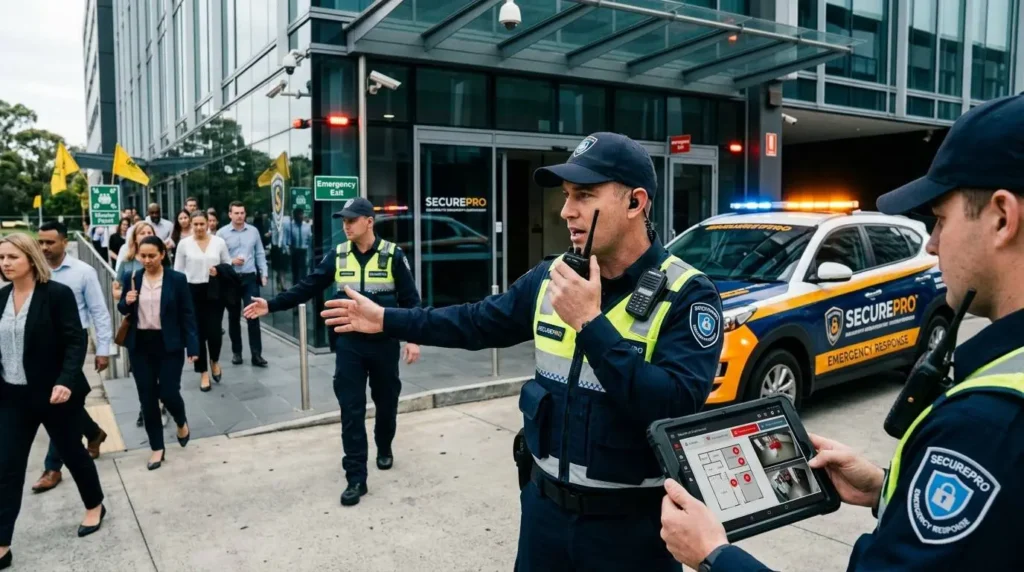
Security failures rarely happen because a team lacks equipment. They happen because a team lacked a plan. When an alarm fires at 2 am, when a lone officer faces an escalating incident, or when a warehouse shift-change creates an unguarded window, the difference between a contained situation and a serious loss comes down to whether your emergency response strategies were built in advance or improvised under pressure.
Why Most Emergency Response Plans Fail Before They Are Tested
Most UK security operations have some version of a response plan. The problem is that most plans are written for ideal conditions: a full team, a working communication line, and a clear chain of command. Real emergencies do not arrive in ideal conditions.
Plans fail when a senior officer is absent, and no deputy has decision-making authority. They fail when an alarm triggers, but the response window stretches beyond the point where intervention matters. Effective emergency response strategies begin by assuming the plan will be stress-tested at its weakest point, not its strongest, and they are built to hold regardless.
Build a Tiered Command Structure That Survives Personnel Loss
A security team without a functioning command structure during a crisis becomes a group of individuals making competing decisions. The most common emergency response strategies address this with a simple principle: every role in the response chain must have a named deputy.
If the site supervisor is unreachable, the next officer in the structure must have pre-authorised authority to make decisions, contact emergency services, and initiate lockdown or evacuation. That authority cannot be granted during an incident; it must exist before one. MSS deploys all teams with a documented tier structure that activates automatically when a senior position is unavailable, so decision-making never stalls during an active incident.
Close the Dead Zone Between Alarm Trigger and Officer Arrival
The window between an alarm activating and a response officer arriving on-site is the highest-risk period of any security incident. It is also the period that almost no published emergency response strategies address directly. Most plans document what to do before an alarm fires and what to do after an officer arrives, but not what must happen in the minutes between.
MSS response protocols close this gap through a verified trigger process. When an alarm activates, the control room immediately attempts remote verification, contacts the client’s designated emergency contact, and dispatches the nearest available officer simultaneously. No step waits for the previous step to complete. That parallel action structure is what compresses response time from the industry average of over an hour to under 20 minutes in most covered areas.
Design an Emergency Cover That Protects the Team Itself
Security teams plan for client-facing emergencies but rarely plan for internal ones. What happens when an officer is taken ill mid-shift, injured on-site, or simply fails to show? An unguarded shift does not just create a security gap; it creates a liability gap, a contractual gap, and a documented failure that can affect client relationships.
This is where our Emergency Cover Services function as a direct component of a working emergency strategy rather than an optional add-on. Emergency cover means a trained, SIA-licensed replacement can be deployed at short notice to maintain continuity at any site, whether the original officer is unavailable for two hours or two days. Emergency response strategies that do not account for team resilience are incomplete by design.
Lone Worker Emergency Protocols for Out-of-Hours Sites
A single officer covering a large commercial property, an unmanned distribution site, or a multi-building industrial estate faces a different set of emergency response challenges than a team deployment. There is no colleague to coordinate with, no immediate backup, and no second pair of eyes on a developing situation.
Effective emergency response strategies for lone worker environments require three non-negotiable elements: scheduled welfare check-ins at defined intervals, a pre-agreed escalation procedure if a check-in is missed, and direct control room contact available at all times. MSS lone worker protocols include automated check-in systems and a response procedure that initiates within minutes of a missed contact window, ensuring that an officer on a solo deployment is never operationally isolated, regardless of the time or site location.
Warehouse and Logistics Emergency Sequencing
Warehouse and logistics sites present a specific emergency risk profile that generic security plans rarely account for. Shift-change windows, particularly handovers between day and night shifts, create predictable periods of reduced coordination and elevated access vulnerability. Loading dock operations during active hours produce a further exposure point where access control weakens, and visitor verification becomes inconsistent.
Our Warehouse & Logistics Services include site-specific emergency response strategies built around the operational pattern of each facility. That means knowing which zones carry the highest risk during which hours, having a documented response sequence for loading dock incidents, and ensuring that shift-change handovers are structured security events rather than informal staff replacements. The emergency plan for a warehouse is not a generic plan applied to a different address; it is a sequence built around how that specific facility operates.
Document Every Response for Insurance and Legal Protection
Every emergency response generates documentation that either protects or exposes the client and the security team. A timestamped incident report, a GPS-logged officer attendance record, and a structured post-incident summary are not administrative tasks; they are direct inputs into insurance claims, regulatory compliance, and any subsequent legal proceedings.
Emergency response strategies that do not include a documentation requirement at every stage create an evidence gap that can be used against the client. MSS officers complete a mandatory incident log for every alarm response, every welfare check, and every observed or reported anomaly. That record serves as proof of professional management during a crisis and a clean record of the response sequence if a claim or dispute follows.
First Responder Handover Without Confusion
When police, fire, or ambulance services arrive at an active incident, the quality of the handover from the on-site security team directly affects how quickly they can act. Confusion about site layout, access points, or the current status of the incident wastes the minutes that matter most.
Effective emergency response strategies include a pre-prepared site briefing format, a concise handover document that covers the site layout, known access points, the nature of the incident, and any actions already taken by the security team. MSS officers carry site-specific briefing cards for every client location they cover. When a first responder arrives, the handover is structured, clear, and delivered in under 90 seconds. That preparation is not difficult, but it is almost universally absent from the emergency response strategies competitors publish.
Testing Your Strategies: Drills That Expose Real Gaps
A plan that has never been tested under pressure is a hypothesis. Scenario drills convert emergency response strategies from documented intentions into practised responses. The goal of a drill is not to confirm the plan works; it is to find the point where it breaks.
MSS recommends two types of testing for client sites: tabletop exercises, where the site team walks through a scenario verbally and identifies decision points and gaps; and live deployment tests, where a real response is triggered without advance notice to the team to measure actual response time and protocol adherence. Both types expose different failure modes. Together, they convert emergency response strategies into operational muscle memory that holds when real pressure arrives.
FAQs
How often should emergency response strategies be reviewed?
At a minimum, annually, but also after any significant incident, following a change in site personnel, when a client adds a new location, or when operating conditions shift. A strategy built around last year’s site layout or team structure may not address current vulnerabilities.
What is the difference between an emergency response strategy and an incident response plan?
A strategy defines the principles and priorities that guide decision-making across all emergency types. An incident response plan is a specific, documented procedure for a defined scenario. A functioning security operation needs both strategies, which provide the framework, and plans provide the step-by-step execution.
Do MSS officers carry site-specific emergency documentation?
Yes. Every officer deployed to a client site carries documentation covering the site layout, emergency contacts, access point details, and pre-agreed response sequences. That documentation is reviewed and updated as part of the contract management process.
What qualifies as an emergency requiring an immediate response call?
Any situation that poses an active or imminent risk to people, property, or operations, including alarm activations, signs of forced entry, a welfare check failure, fire or smoke detection, or an escalating confrontation on-site. If a situation is developing and unclear, the correct response is always to escalate immediately rather than wait for certainty.